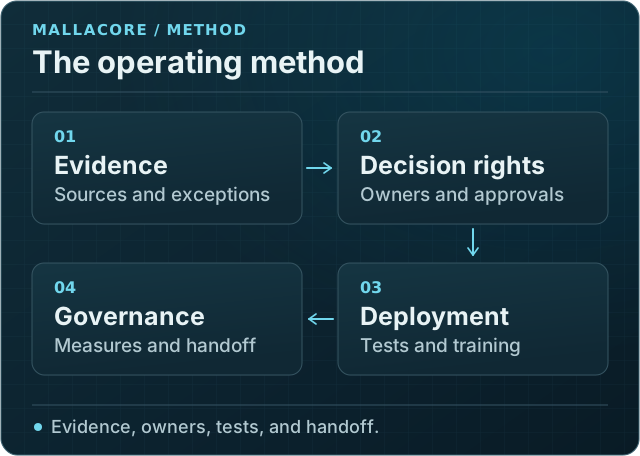
Evidence
Understand the real work.
Review the existing workflow, its exceptions, the source information, and the cost of the problem. Make assumptions and missing information visible.
OUR METHOD
Before we build, we agree with the people who own the workflow on what has to work, where a person reviews it, and how we’ll test it. We call that agreement the Pass Bar.
Evidence
Review the existing workflow, its exceptions, the source information, and the cost of the problem. Make assumptions and missing information visible.
Decision rights
Define the owner, approvals, access, and escalation paths. Agree where a person reviews the work and what the system may do.
Deployment
Agree on routine cases, exceptions, and what counts as passing. Build and test the scoped workflow in the selected systems. Review the results with the workflow owner, train the team, and agree on acceptance before release.
Governance and adoption
Document the handoff, measures, change process, and support responsibility. Review what the team actually uses and where the system needs attention.
The Map weighs buying, integrating, redesigning, and building against the evidence and cost of the operating problem. That may point to a scoped next step, a change in the workflow, or a decision to stop.
Start with a MapYOUR NEXT MOVE
The report nobody trusts. The handoff that stalls. The work that still depends on one person. Start there.
Let’s talk about it